Election campaign funding and disclosing it
A candidate’s election funding may consist of
- the candidate’s own funds and loans taken out by the candidate contributions received by the candidate, the candidate’s support group or other entity operating exclusively
- for the purpose of promoting the candidate
- other financial support.
Disclosing the donor
The name of the donor shall be stated in the election funding disclosure if the value of contributions provided by the donor is at least
- EUR 1,500 in parliamentary elections, county elections, European Parliament elections and presidential elections
- EUR 800 in municipal elections
- EUR 800 if the candidate is standing in both the county and the municipal elections at the same time.
The donor can be a private individual, a company, a political party, a party association or another entity.
The discloser shall state the name of the donor at least if the contributions exceed the above-mentioned limits referred to in the Act on a Candidate's Election Funding.
The candidate may also separately disclose contributions below these limits. However, the name of a private individual may not be published without their express consent if the amount donated by them is lower than election-specific limit. The name of a company, political party, party association or other entity may also be indicated in connection with smaller contributions.
Non-monetary support
In addition to actual financial support, non-monetary support the value of which can be measured in monetary terms is considered to be support. A candidate may gain even significant benefits from various services, for example.
The value of all support measurable in money shall be assessed in monetary terms and disclosed as support in the election funding disclosure. Non-monetary support may include, for example, free advertising space provided by newspapers or free services provided by companies in their own sectors, such as professional design of a website or the production of other campaign material, such as posters and leaflets.
Conventional quantity discounts or conventional free services provided by newspapers and other companies are generally not considered to constitute support and do not have to be included in the disclosure.
If a candidate’s supporter pays for an advertisement or other costs chargeable to the candidate on the candidate's behalf, the candidate shall disclose the value of the cost in the election funding disclosure as support if the candidate has had control over the generation of the cost.
Classification of funding
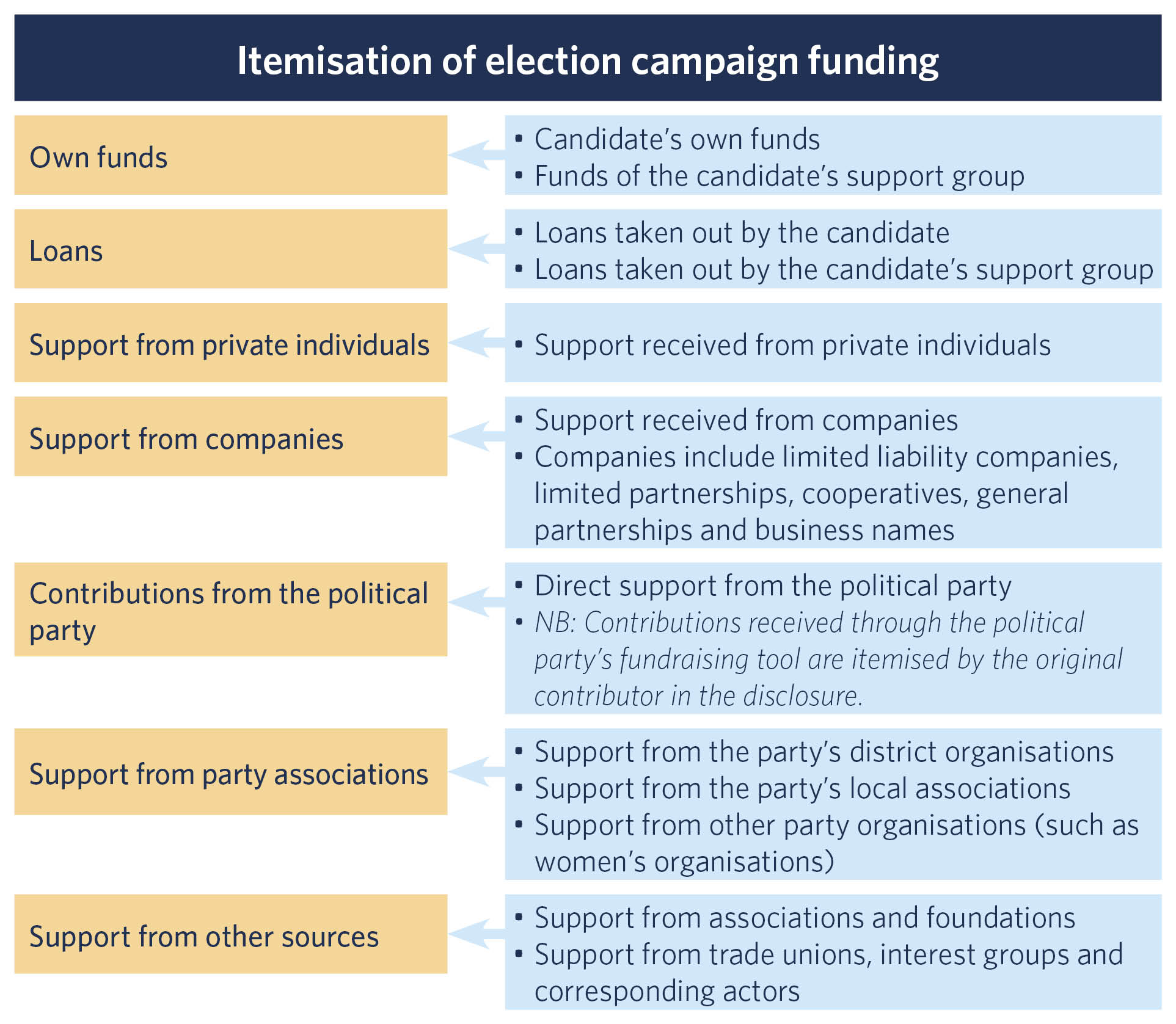
Campaign funding is classified in the election funding disclosure as follows:
- the candidate's and the support group's own funds
- loans taken out by the candidate and the support group
- support received from private individuals
- support received from companies
- support received from a political party
- support received from party associations
- support received from other entities
From the point of view of election funding, a candidate and the candidate's support group are interpreted as a single entity, i.e. loans taken out for the campaign by a candidate and their support group are considered as a whole.
Support received from private individuals is considered to include contributions provided by private individuals (natural persons). Contributions received from private individuals through a political party's fundraising tool, for example, shall also be reported as support received from private individuals.
Support received from companies is considered to include contributions provided by businesses. Typical business actors include limited liability companies, limited partnerships, cooperatives and business names.
Direct support provided by a political party for a candidate's campaign is disclosed as support received from a political party. However, significant individual contributions collected through the fundraising tool of a political party and transferred by the political party shall be reported directly in the category to which the original donor belongs – not as support received from a political party or as transferred support.
A party association refers to an association that belongs to a political party or its member association and that meets the membership requirements of its parent organisation. The most typical party associations are the district and local organisations of political parties.
Other entities referred to in the Act on a Candidate's Election Funding are all entities not belonging to the above categories, such as interest groups, trade unions, foundations and associations (excluding party associations). Support received from them should be disclosed as support received from other entities.
Transferred support
Transferred support refers to contributions whose original source is other than the entity that transfers them to the candidate. The candidate should always ensure whether the support received also includes transferred support. The original source of transferred support and the intermediary transferring the support shall be disclosed in the election funding disclosure if the value of support exceeds the limit laid down in the Act on a Candidate's Election Funding for support to be disclosed separately.
Example of transferred support and its disclosure in parliamentary elections
A candidate organises an election seminar in cooperation with Seminar Organiser Ltd. The participants in the seminar pay participation fees to Seminar Organiser Ltd, which transfers the fees to the candidate. The participation fee is EUR 750 per participant, and a total of eight tickets are sold to seven companies. Seminar Organiser Ltd pays EUR 6,000 to the candidate.
As the sum transferred by Seminar Organiser Ltd exceeds the limit laid down in the Act, the candidate shall disclose the details of Seminar Organiser Ltd and the amount of support in the election funding disclosure in the itemisation under section 2.4 Support received from companies.
One of the participants, Business Supporter Ltd, has purchased two tickets for the seminar for EUR 1,500 in total. As this amount also exceeds the limit laid down in the Act, the details of Business Supporter Ltd and the amount of support shall be disclosed in the election funding disclosure. The original source of transferred support shall be indicated in the election funding disclosure in the itemisation under section 2.8 Transferred support.
Support for consideration
Support for consideration refers to a situation where the donor receives goods or services from the candidate in return for the support they provide. Usually the candidate also incurs costs from obtaining support for consideration. Costs may be caused, for example, by sales and collection activities.
The main rule in disclosing election funding is that the data on election funding (contributions and costs) are calculated and disclosed in gross terms. This means that the funding received is reported in full without deducting costs. Disclosing the funding in gross terms promotes transparency.
Costs resulting from obtaining support for consideration are reported in gross terms as part of the total election campaign costs under Election campaign costs. The costs resulting from obtaining support for consideration can also be itemised.
Net amounts are applied only when it is assessed whether a contribution should be disclosed separately. In the case of support for consideration, the individual donor and the value of the contribution shall be disclosed if the net contribution received from the donor is at least EUR 800 in municipal elections or EUR 1,500 in parliamentary elections, European Parliament elections or presidential elections. The disclosure obligation thus arises if the difference between the price paid by the donor for the goods or services and the costs incurred by the candidate for the purchase of the goods or services is at least EUR 800 in municipal elections or EUR 1,500 in parliamentary elections, European Parliament elections or presidential elections.
A private individual's name may not be disclosed without their express consent if the net value of their support is less than EUR 800 in municipal elections or EUR 1,500 in parliamentary elections, European Parliament elections or presidential elections. The discloser is always responsible for obtaining the consent.
Example of disclosing support for consideration in municipal elections
For election campaign funding, a candidate for municipal elections has bought an artwork, for which he paid the artist EUR 450. The candidate discloses the gross costs as part of the total election campaign costs and itemises them in section 1 of the election funding disclosure.
The candidate sells an artwork as part of his election campaign to Company Ltd. Company Ltd pays the candidate EUR 1,300 for the artwork, which makes the company a supporter of the candidate's election campaign. The net value of the support paid by Company Ltd is EUR 850 (EUR 1,300 – EUR 450). In this case, the candidate has received an individual net contribution of EUR 850, which exceeds the limit of the disclosure obligation set for individual contributions in municipal elections. Thus, the contribution shall be disclosed separately in the election funding disclosure. In his election funding disclosure, the candidate discloses EUR 1,300 in section 2.4 Support received from companies, and in section 2.4b The support includes support for consideration of at least EUR 800 net, he discloses separately that he received the contribution of EUR 850 (net) from Company Ltd.
If the value of the net support were less than EUR 800 in the example case, the candidate would not be obliged to disclose the contribution separately (in section 2.4b of the election funding disclosure).